
Do empty base slots still earn Cash?
No. A Blue Lock Farm character earns while it occupies a slot and kicks balls into crates. An empty slot pays nothing online and nothing offline.

Blue Lock Farm characters on Place 132767904294856 (Finding Illusions) leave a locker and earn only after they stand on a base slot. A placed character kicks balls. Those balls become crates. You sell the crates for Cash. An empty slot pays nothing, including while you are offline. This page has observed per-ball reads and an on-screen Index claim. It does not have a name list, a tier list, or official portraits. Verified October 2, 2026. Play on Roblox.
| Fact | Detail |
|---|---|
| Place | 132767904294856 · 8-player servers · no soccer matches |
| Earns when | The character occupies a base slot and kicks balls into crates |
| Empty slot | Pays nothing, online or offline |
| Index claim | About 1,261 varieties on one panel. Not a verified roster |
| Per-ball samples | Player-observed reads from one session, from about $26 up to a later $1.8 million |
| Named fields | Rarity, CPS, Damage, Health, Cash Multiplier, Grade, Trait, Variant — no complete public table |
| Portraits | No official portrait set to attach. This page stays text |
| Matches | None. The character works on your plot. No rebirth |
The locker grants the character. The slot is what turns that character into Cash. Until the body is on a pad, the plot treats that pad as empty.

A character in a locker that has not finished, or sitting in inventory for a menu, is not filling a pad. One session was handed a locker shortly after joining and still had to place the result. A later paid locker followed the same rule: open, then stand it on the base. Cash you already spent on the tag does not pay you back until that happens.
Locker bands, from the cheap tags near 150 Cash through the high tags, are purchase prices. They are written up on lockers. This page starts at the moment the door opens. If the plot is full, compare per-ball numbers before you remove anyone. If a pad is empty, place the character you have. An ordinary per-ball read on an empty pad beats a stronger character you have not opened yet.
Placed characters keep kicking while you are away. Empty slots do not start paying because you own a character somewhere else. A full ground floor is also the signal, in one session, that Floor 2 and more slots were worth the expansion. More slots only help after you can put a body on them.
The leave-the-game checklist, and why an unopened locker is not a filled slot, is on offline earnings. The per-ball numbers in the next section are how you choose which body deserves the pad you do have.
Every figure below is a player-observed on-screen read from one session. The live number on your character wins if it disagrees. None of these rows is a starter wage or a rate card for a named unit.
| Read | What the session showed | Status |
|---|---|---|
| Early pair | About $26 per ball at level 1, about $50 per ball at level 5 | Player-observed |
| Second early pair | About $65 per ball at level 1, about $126 per ball at level 5 | Player-observed |
| Mid read | About $339 per ball, with level 20 shown near $7,000 per ball | Player-observed |
| Million-Cash locker | About $1,000 per ball at level 1, about $4,000 at level 10, about $25,000 at level 20 | Player-observed. One pull |
| Later read | About $1.8 million per ball. Level for that line is not pinned here | Player-observed |
| Whole base | About $2,850 per second after the plot was filled, early in that session | Plot total, not one character |
The million-Cash locker is a purchase. About $1,000 per ball is what that one pull displayed at level 1. Those are different units. A 1,000 Cash locker on the belt is a third number again: a cheap tag, not a per-ball payout. When you are deciding a replacement, ignore the Cash already spent and read the per-ball line on the unit you would remove.
Level changes the same character. The $26 read and the $50 read are one early unit at level 1 and level 5. The $65 and $126 pair is another early unit at those same two levels. The $339 line and the level-20 line near $7,000 belong together as one mid read, not as two characters. Do not average these pairs into a "level 5 wage." Your pull can sit far from every row.
One early unit carried a Diamond mutation label and read about $50.41 per ball. That is a single modifier on a single pull. This page does not turn it into a mutation list, a drop rate, or a second roster.
Use the table as a scale check: early pads in that session were tens of Cash per ball, a later kept unit showed hundreds and then thousands at level 20, and a million-Cash locker pull reached about $25,000 per ball at level 20 before a later read hit about $1.8 million per ball. The next section explains why the Index counter does not name any of those units.
Matched by build plan, shared topics, and guide progression — not random related links.
The Index is a collection counter. It is not a shop, and the number on it is not a character list you can build a tier page from.
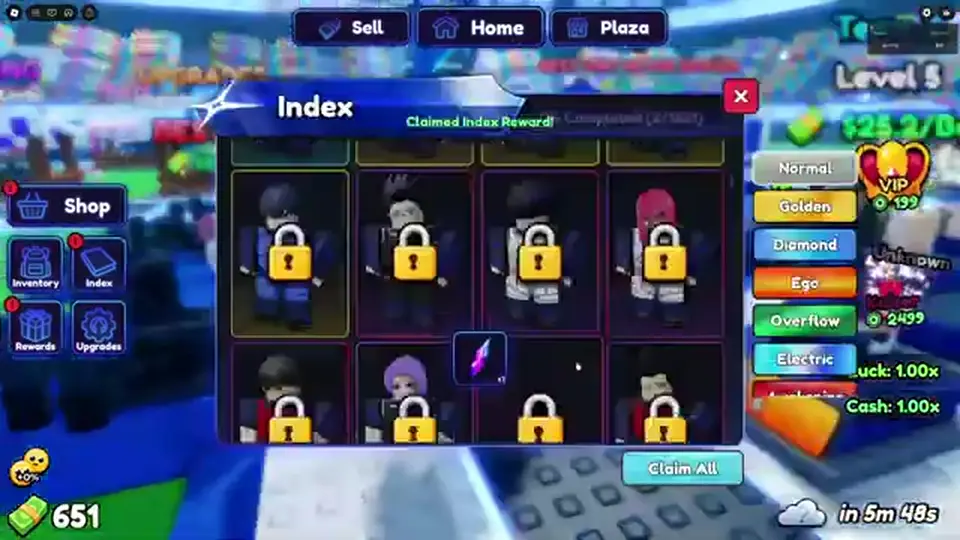
| On-screen item | How to use it | How not to use it |
|---|---|---|
| About 1,261 varieties | A claim printed on the Index in that session | Not an official roster size or drop table |
| 37 unlocked out of 1,261 | A later read of the same counter | Not a list of the 37 names |
| A name you pulled | Safe to remember for your own plot | Safe to publish here only after it is verified on a result |
| A manga or rivals name | A different work | Not a unit on Place 132767904294856 until the locker shows it |
| Portrait grid | None attached on this site | No stand-in art until an official face exists |
In that session the Index displayed 1,261 varieties, and a later look at the same counter read 37 unlocked out of 1,261. Treat both figures as on-screen claims. They do not identify which characters exist, which locker can roll them, or which one kicks harder. Publishing 1,261 rows from that number would mean inventing names. This site will not do that.
Look a name up after you have pulled it, if you want to see whether the counter moved. The first hour does not need the Index at all. Placement and the per-ball comparison come first. The Plaza stops around the Index — rank, traits, and the market — are written on the beginner guide as a later trip, once you can point at your best pad.
Public notes do not include an official portrait set, a complete rarity ladder, or drop rates by name. A table of faces with guessed labels would look like a roster. The cells on this page stay text for that reason. When a name is verified on a locker result and a clear portrait exists, a future row can carry both. Until then, strength is the per-ball number you can read on the unit you own.
The fields players expect under a portrait — rarity, damage, trait, and the rest — are named in notes and still lack a public grid. That gap is the next section, separate from the Index count.
Notes name eight fields. They do not publish a filled table for them. If your HUD shows a value, that value is the spec for that character. Do not backfill the blanks from another game.
| Field | What it is for | Public status |
|---|---|---|
| Rarity | How the game groups the pull | Named. Ladder and drop rates unpublished |
| CPS | Cash per second on that unit or the line the HUD uses | Named. No per-character CPS sheet |
| Damage | Used by trait multipliers and tower-style fights | Named. Base damage by character unpublished |
| Health | Same. A trait can multiply it | Named. Base health by character unpublished |
| Cash Multiplier | Scales crate income. Grade and some traits touch it | Named. No full multiplier ladder here |
| Grade | A separate roll at the Plaza Ranking Stand | See the grade page. Ladder unpublished |
| Trait | One buff, rerolled with a Trait Token | Full published odds are on the traits page |
| Variant | A special-form field. A Variant Token exists as a code reward | Forms and recipes unpublished |
Rarity text, a CPS line, Damage, Health, and a Cash Multiplier can all appear on a character card in play. That is not the same as a wiki table with every variety filled in. The Index claim of about 1,261 varieties makes a complete grid even less responsible to guess. Per-ball Cash, which you can see without a stat compendium, remains the replacement test on the plot.
Damage and Health matter once you take a character to the tower. They are not a versus-match loadout, and this Place does not start a soccer match. If a card shows those stats and a trait multiplier, the multiplier's odds and the keep rules live on traits. The base stat under the multiplier is still whatever your card prints.
Grade is a Ranking Stand roll paid with a Grade Token or Cash. One session described an S grade as a ×3 income boost on that unit. A full grade ladder is not published, so that ×3 stays one session's claim. Rolls, token sources, and why you only grade a keeper are on grade.
A trait is a separate buff on the same character. Variant is named as a field, and ADMINABUSE can grant a Variant Token, but the forms themselves are not defined here. Code rewards are on codes. None of the three replaces an empty slot. The last section is the keep-or-replace test that decides who is worth those spends.
A keeper is the character you would still want on the pad after the next locker opens. Everything else can move.
| Plot state | Action |
|---|---|
| Empty slot | Place the character that just opened |
| Full plot, new per-ball number is higher | Remove the weakest kicker and place the new one |
| Full plot, new number is lower | Leave the current kickers down |
| You are unsure | Leave the earners. One session kept units around $50 per ball until a better tag was actually in hand |
| You want to rank, grade, or reroll | Only pick up a unit you have decided to keep. One session needed the character in inventory for rank |
| You are about to log off | Put the best characters back on slots. Offline Cash follows what is placed |
Trait Tokens and Grade Tokens are wasted on a character you are about to delete from the pad. The published trait odds, and which rows favor crate Cash versus the tower, are on traits. Grade Cash on a strong character can run into the millions per roll in public notes. That cost belongs on a per-ball number you intend to keep. The stand itself is grade.
Locker luck and crate-cash upgrades do not choose the character for you. They change the belt and the sale. Slot order stays: fill, compare per-ball numbers, then upgrade. The upgrade board is upgrades.
If a slot is empty, go back to lockers and buy a tag you can place. If every slot has a kicker, open traits for a keeper, or the tower when you need more Trait Tokens: tower. Leaving the earners down is offline earnings.
The FAQ below answers the roster question and the empty-slot question in short form. It does not add names.
No. A Blue Lock Farm character earns while it occupies a slot and kicks balls into crates. An empty slot pays nothing online and nothing offline.
Not published. The Index in one session claimed about 1,261 varieties, later read as 37 unlocked out of 1,261. That counter is not a roster, a drop table, or a tier list. This page does not invent names.
Only a name on a locker result from Place 132767904294856 belongs here. Blue Lock Rivals and the manga are different works.
There is no official starter wage. One session showed about $26 per ball at level 1 and about $50 at level 5, another early unit about $65 and about $126 at those levels, and later reads from about $339 up to about $1.8 million per ball. Your HUD wins.
No. Compare the per-ball number after the locker opens. The million-Cash tag and the $1,000-per-ball pull in that session were one purchase and one result, not a rule for every tag.
Rarity, CPS, Damage, Health, Cash Multiplier, Grade, Trait, and Variant are named in public notes. A complete filled table, rarity ladder, and portrait set are not. Read the card you pulled.
Fill empty slots first. Grade rolls are on grade. Trait rerolls are on traits. Both belong on a character you will leave on a pad.
Yes, if they are on slots. Inventory and unopened lockers do not fill a pad. See offline earnings.
Matched by build plan, shared topics, and guide progression — not random related links.